
Local SEO for Hospitals: A Google Business Profile Guide
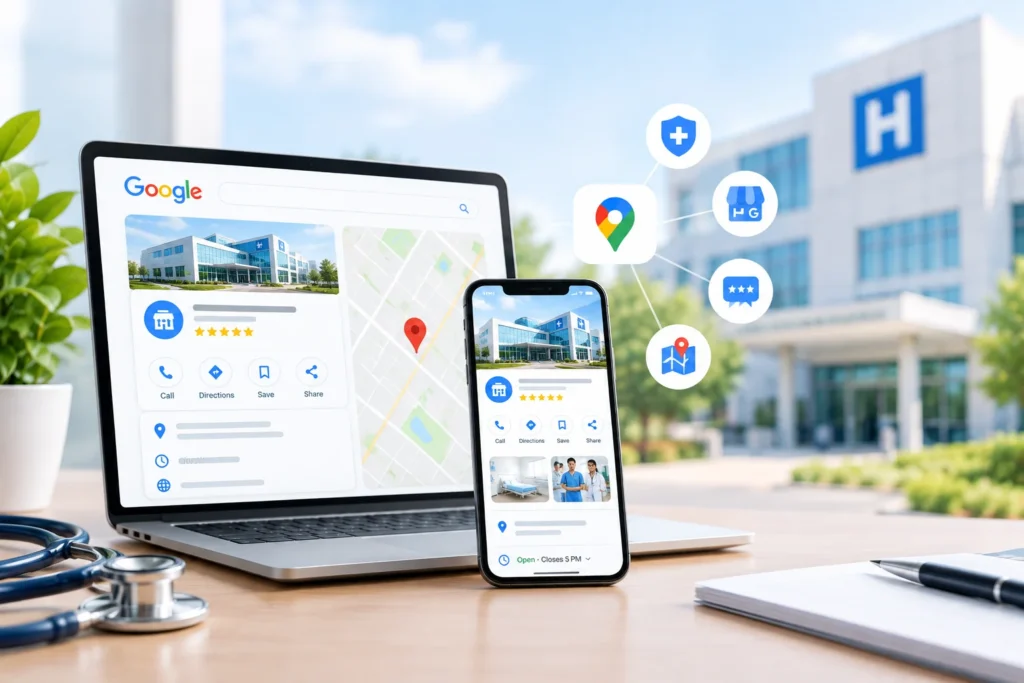
Local SEO for Hospitals: A Google Business Profile Guide For hospitals, being visible when patients search for nearby healthcare services can make a real difference. Local SEO for hospitals helps your hospital appear in Google Search and Maps when people look for services, doctors, departments, or healthcare facilities in their area. A well-optimized Google Business Profile (GBP) gives patients useful information before they visit. It can show your hospital name, location, phone number, hours, services, photos, reviews, and other important details. For hospitals in India, GBP should be treated as part of a wider local search strategy rather than a standalone marketing activity. Your profile, website, reviews, citations, and brand information should all communicate the same information. Book Your Free Consultation What Is Local SEO for Hospitals? Local SEO for hospitals is the process of improving a hospital’s visibility in location-based searches. It helps connect your hospital with people searching for relevant healthcare services in a specific city or area. For example, a patient may search for “multispecialty hospital in Delhi,” “best IVF hospital in Hyderabad,” or “cardiology hospital near me.” These searches have clear local and service-related intent. Google considers factors such as relevance, distance, and prominence when determining local search results. Keeping your Business Profile complete and accurate helps Google understand your business and match it with relevant local searches. For hospitals, this means local optimization should focus on accurate information, relevant services, genuine patient experiences, strong website content, and consistent brand signals. Why Google Business Profile Matters for Hospitals Google Business Profile gives hospitals a presence across Google Search and Google Maps. Patients can quickly find important information without first visiting the hospital website. A complete profile can include the hospital’s address, contact details, opening hours, website, services, photos, reviews, and other available business information. Google recommends that businesses accurately represent themselves, maintain precise location information, and select only the categories that appropriately describe their core business. This makes GBP optimization an important part of hospital local SEO, particularly for searches where patients are looking for a healthcare provider in a specific location. How to Optimize Google Business Profile for Hospitals 1. Claim and Verify the Hospital’s Profile Start by claiming the official Google Business Profile for the hospital and completing the verification process. Verification helps establish that the hospital is authorized to manage the profile. It also allows the organization to manage important information that appears across Google. For hospitals with multiple branches, each eligible location should have accurate information representing that specific facility rather than combining different locations into one profile. 2. Use the Correct Hospital Name The hospital name on Google should match how the hospital is actually represented in the real world. Avoid adding extra keywords such as “Best Hospital in Delhi” or “Top IVF Hospital” to the business name simply to target search queries. Google’s guidelines require businesses to represent themselves consistently as they are recognized in the real world. This is important for both local search and brand consistency. Your hospital name should match your website, signage, directories, social profiles, and other trusted sources. 3. Choose the Right Primary Category Your primary category helps Google understand what type of organization you operate. Choose the most specific category available that accurately represents the hospital. Additional categories can be used where appropriate, but they should not be added simply to target every healthcare-related keyword. Google specifically recommends choosing the fewest categories necessary to describe the core business and selecting categories that accurately represent the business. For example, a hospital should not select unrelated categories just because those terms have search volume. 4. Keep NAP Information Consistent NAP stands for Name, Address, and Phone number. These details should remain consistent across your website, Google Business Profile, healthcare directories, and other relevant platforms. For a hospital in India, make sure the complete address includes the correct locality, city, state, and PIN code where appropriate. Also check that the phone number connects patients to the correct hospital or department and that the website URL leads to the appropriate official page. 5. Write a Clear Business Description Your Google Business Profile description should explain what the hospital offers and what makes the facility relevant to patients. Mention important areas such as major departments, specialties, location, and the type of healthcare services provided. Avoid turning the description into a list of keywords. Google recommends using the description to explain what the business offers, what makes it special, and other useful information for customers. A natural description is more useful than repeatedly writing phrases such as “best hospital,” “top hospital,” or “best hospital in India.” 6. Add Important Hospital Services Patients often search for healthcare services rather than the hospital name itself. Create and maintain relevant service information for areas such as cardiology, orthopedics, gynecology, fertility treatment, emergency care, diagnostics, or other specialties offered by the hospital. This supports GBP optimization for hospitals because it gives Google and potential patients clearer information about what the hospital actually provides. Keep service names factual and aligned with the services available at the facility. Do not add services simply because they are popular search terms. 7. Upload Authentic Hospital Photos Photos help patients understand what the hospital looks like before visiting. Consider adding clear images of the hospital exterior, reception area, waiting rooms, departments, facilities, equipment, and relevant staff or team areas. Google recommends that Business Profile images be clear, well-lit, and representative of reality rather than heavily edited or excessively filtered. For healthcare organizations, authentic photography is particularly important because patients may use images to understand the environment and facilities. Book Your Free Consultation 8. Manage Reviews and Patient Feedback Reviews play an important role in shaping a hospital’s online reputation and helping patients evaluate their options. Patients may read them when comparing healthcare providers or deciding where to make an appointment. Encourage genuine patients to share their experiences, but do not offer incentives in exchange for positive reviews. Google states that reviews should reflect genuine experiences and prohibits paid
Local SEO for Hospitals: A Google Business Profile Guide Read More »